
VALD ForceFrame: isometric strength testing for hips, knees and shoulders
VALD ForceFrame is a fixed testing frame with load cells that measure how hard you push or pull without the joint moving, known as isometric strength. At Adapt in North Sydney, physiotherapists use it to compare left and right sides and to track strength between reviews in shoulder rehab, knee replacement rehab and other programs.
Where ForceFrame testing is used
The frame is reset for each body area, and your physiotherapist chooses positions that suit your phase of physiotherapy.
Shoulder
Rotation and pressing positions that show how each shoulder produces force.
Hip
Squeeze and push-out positions that compare inner and outer hip strength.
Knee
Quadriceps and hamstring tests with the knee held at a set angle.
ForceFrame and ForceDecks answer different questions
Both are VALD systems, but ForceDecks captures whole-body movement while ForceFrame isolates one muscle group at a time.
| VALD ForceFrame | VALD ForceDecks | |
|---|---|---|
| Movement | Holding a fixed position while pushing or pulling | Standing, squatting, jumping, hopping and landing |
| What it records | Peak force for one muscle group, left and right | Force from each leg through a whole movement |
| Useful when | Movement is limited or one muscle group needs checking | A sport-like task needs to be assessed |
| Often used in | Shoulder, hip and earlier knee rehab | Later lower-limb rehab and return to sport |
How a ForceFrame test runs
Each test is short, and the result is compared with your other side and your previous visits to build a limb symmetry picture.
Set the frame
Pads and height are adjusted to your body and the area being tested.
Take the position
The physiotherapist positions the joint at a set angle so each side is tested the same way.
Push or pull
You complete a few maximal efforts against the pads, with rest between trials.
Compare
Left and right results, and previous visits, are reviewed together.
Strength numbers that steer the gym program
The result sets which side or muscle group gets more work and how load rises in the next block, through progressive loading inside gym-based physiotherapy.
How gym-based physio works
How is ForceFrame different from a manual muscle test?
A manual test relies on the examiner's resistance and judgement, while ForceFrame records force in newtons from fixed sensors, so results can be compared across visits and between sides.
Ask about strength testingQuestions about ForceFrame testing
Book a physioIs ForceFrame testing painful?
Efforts are matched to what the area tolerates, and you control how hard you push. Mild effort is expected. Sharp pain is a reason to stop the trial and change the position or leave the test for later.
Can ForceFrame be used for a shoulder injury?
Yes. Shoulder rotation and pressing positions are a common use. The physiotherapist chooses positions around current restrictions and tolerance, then compares sides and earlier results.
How soon after surgery can ForceFrame be used?
Timing follows the surgeon's restrictions and the physiotherapist's assessment. The frame is used when a held position is allowed and a number will inform the next decision, not on a fixed post-operative day.
What happens to my ForceFrame results?
Results are stored with your record, compared at later reviews and explained to you in the session. They help decide which side or muscle group gets more work in the next block.
The physiotherapists who use ForceFrame
Sam and John run the tests and pass the strength targets to the coaching team on the same floor.

Sets ForceFrame positions for the phase and uses the number to direct gym work.
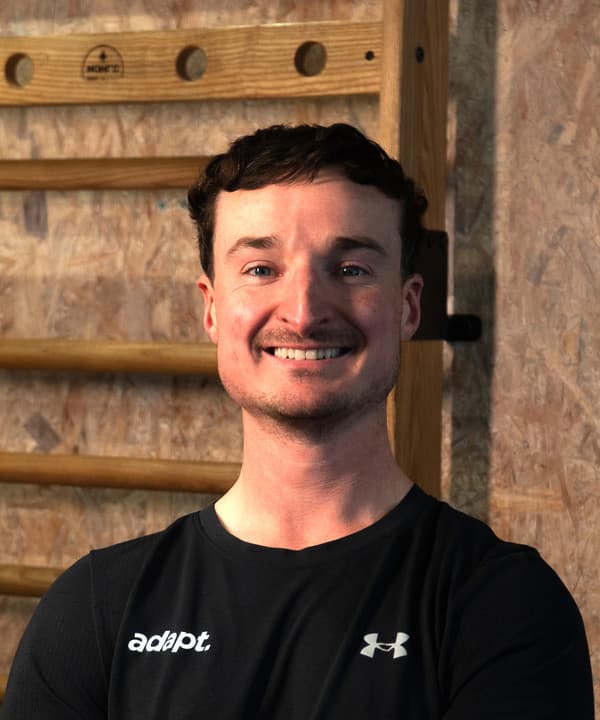
Compares side-to-side isometric force and shares the target with the coaching team.